A team of Cornell economists recently published a report detailing terminal market activity in the US. The report “Wholesale Produce Markets: An On-Site Infrastructure Assessment” is available at https://business.cornell.edu/wp-content/uploads/2026/07/Wholesale_Produce_Markets_Infrastructure_FINAL__VD_.pdf
Researchers estimate that the forty-eight remaining terminal produce markets in the US move 47% of the produce in those metropolitan areas. Most US terminal produce markets serve the Southeast and Eastern seaboards. 28 markets in the South and Southeast are operated by the state departments of agriculture. Only five cities in the Midwest currently host terminal markets: St. Louis, Chicago, Detroit, Louisville, and Cleveland. US terminal markets sometimes also host open retail markets or support farmer wholesale activity, as they do in Ontario. Chicago’s market serves wholesalers only.
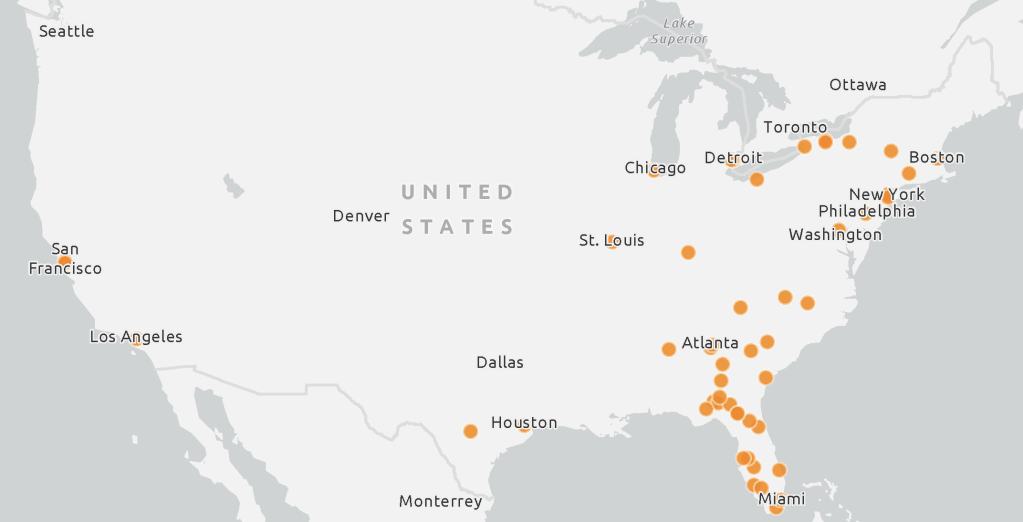
Wholesale produce markets that still in operation face critical infrastructure deterioration and obsolescence that hinder modern product flow, food safety compliance, and operational efficiency. 60% of market managers desire major structural expansions or renovations despite a lack of public or private capital investment.
Core Infrastructure Challenges
- Deteriorating Facilities: Aging physical buildings feature original designs unsuited for modern logistics, cold-chain preservation, and timely produce handling.
- Regulatory Hurdles: Inadequate configurations restrict compliance with contemporary food safety mandates, limiting market access to primary mainstream buyers like major grocery chains.
- Capital Deficits: Rising construction and renovation costs leave most terminal facilities struggling to self-fund essential physical upgrades.
Improvement Priorities
- Dock Upgrades: 60% of surveyed managers prioritize loading dock enhancements, including added space, leveling systems, and temperature-controlled environments.
- Structural Repairs: 50% target core building components such as deteriorating roofs, worn flooring systems, exterior walls, and industrial doors.
- Operational Themes: Investments center around six main pillars: workflow efficiency, food safety compliance, product quality preservation, spatial growth, functional utilities, and centralized business services.

